GitHub

Fox Red Labs / Builds / Motor control, power and sensing

Read six sensors on one plug-in board

Humidity, temperature, light and magnetic field printed once a second, with what each should read.

Medium1 evening

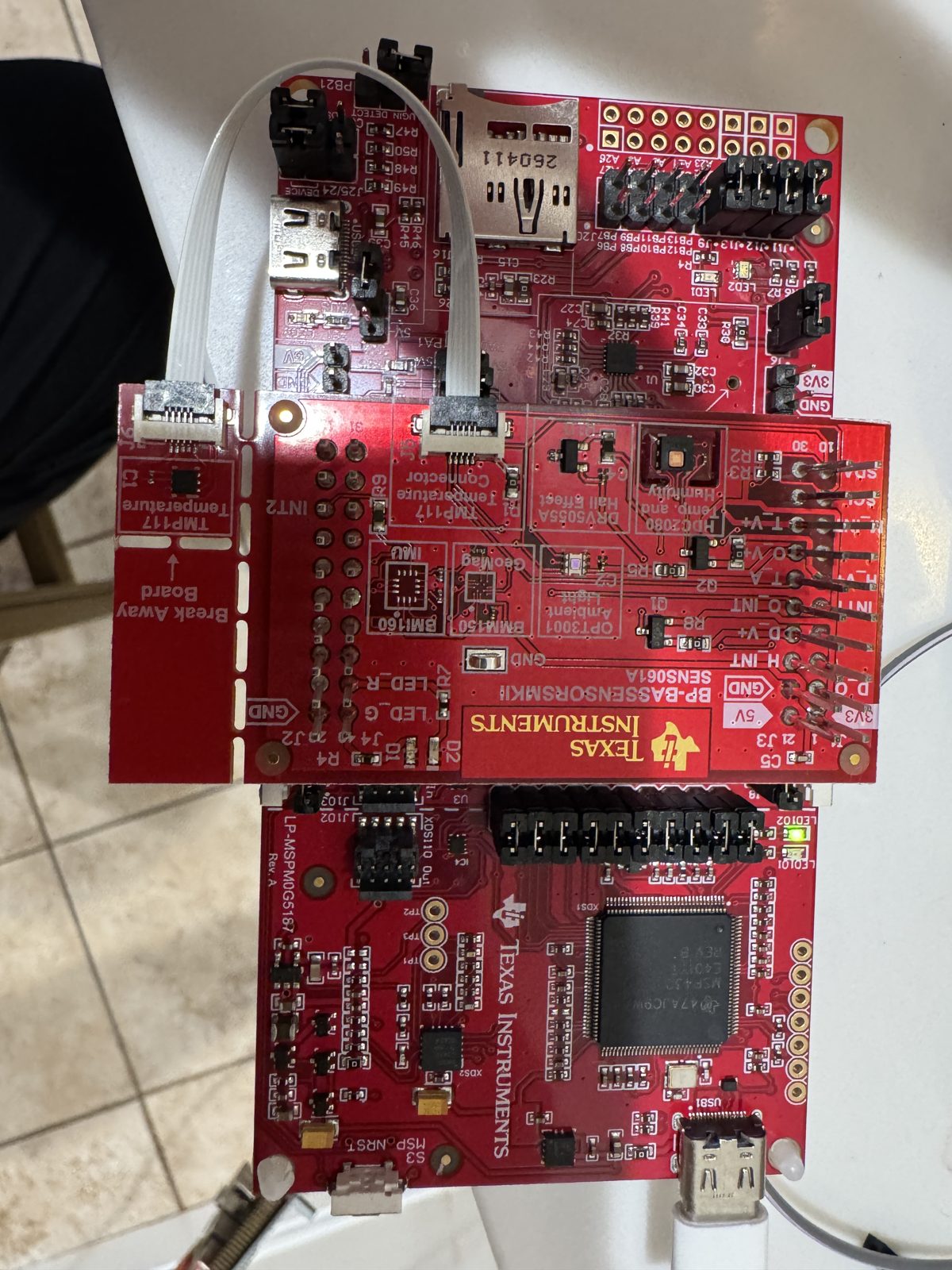
The Sensors BoosterPack plugged on top of an LP-MSPM0G5187

No recorded steps

Some pieces of it have run. There are no recorded steps for this project, so this page does not give any.

What exists:

  • LP-MSPM0G5187: Humidity and temperature, light and the magnet sensor read live; the precise thermometer needs its ribbon cable and the motion sensor did not answer

You would need the board, plus BP-BASSENSORSMKII Sensors BoosterPack plug-in module.

What to build next

Every build. The code for all of them is in the GitHub repository.

Evidence and limitsOn the MSPM0 G5187, three of the six sensors read live: humidity and temperature, light and a magnet sensor. Ran on 1 board. Results, sources, timing and limits.

Which boards ran it

  • Could work LP-MSPM0G5187: Humidity and temperature, light and the magnet sensor read live; the precise thermometer needs its ribbon cable and the motion sensor did not answer

Experiments (4)

StatusWhat was triedResult
Can the LP-MSPM0G5187's NPU count people from a live light reading on the BP-BASSENSORSMKII?
MSPM0 G5187, 2026-10-10
The room-occupancy model runs on the NPU once a second. Its input is a live light reading from the BP-BASSENSORSMKII's OPT3001, taken over I2C. Each call takes 1.30 to 1.32 ms, within 1 percent of the time on stored...
WorksCan an MSPM0 host TI's CC1407P radio, the BP-CC1407P-9-FE, and send sensor readings to another board?
MSPM0 G5187, 2026-10-10
TI's CC1407P host driver runs on the MSPM0G5187 with its driver files unchanged and its two Zephyr-only files replaced by this repo's bare-metal layer. It needs eight wires, because the LaunchPad has pins only on J1...
Could workDoes a stacked BoosterPack stop the LP-MSPM33C321A or LP-MSPM0L1306 coming up after a replug?
mspm33c321a, mspm0l1306, 2026-10-20
Not measured. Two LaunchPad kits with a BoosterPack stacked failed after a replug (one vanished from USB, one refused the debugger); both worked once the BoosterPacks were off.
WorksWhy does the BOOSTXL-AUDIO only click on some LaunchPad kits, and what makes it play on the LP-AM13E230?
AM13E230, 2026-10-20
The BOOSTXL-AUDIO plays a clean 1 kHz tone and a four-voice tune from an MSPM0-style driver when each DAC8311 write is one 16-bit frame with SYNC low for all 16 clocks and the amplifier line is driven low. With two...

Source files

Demos with wiring

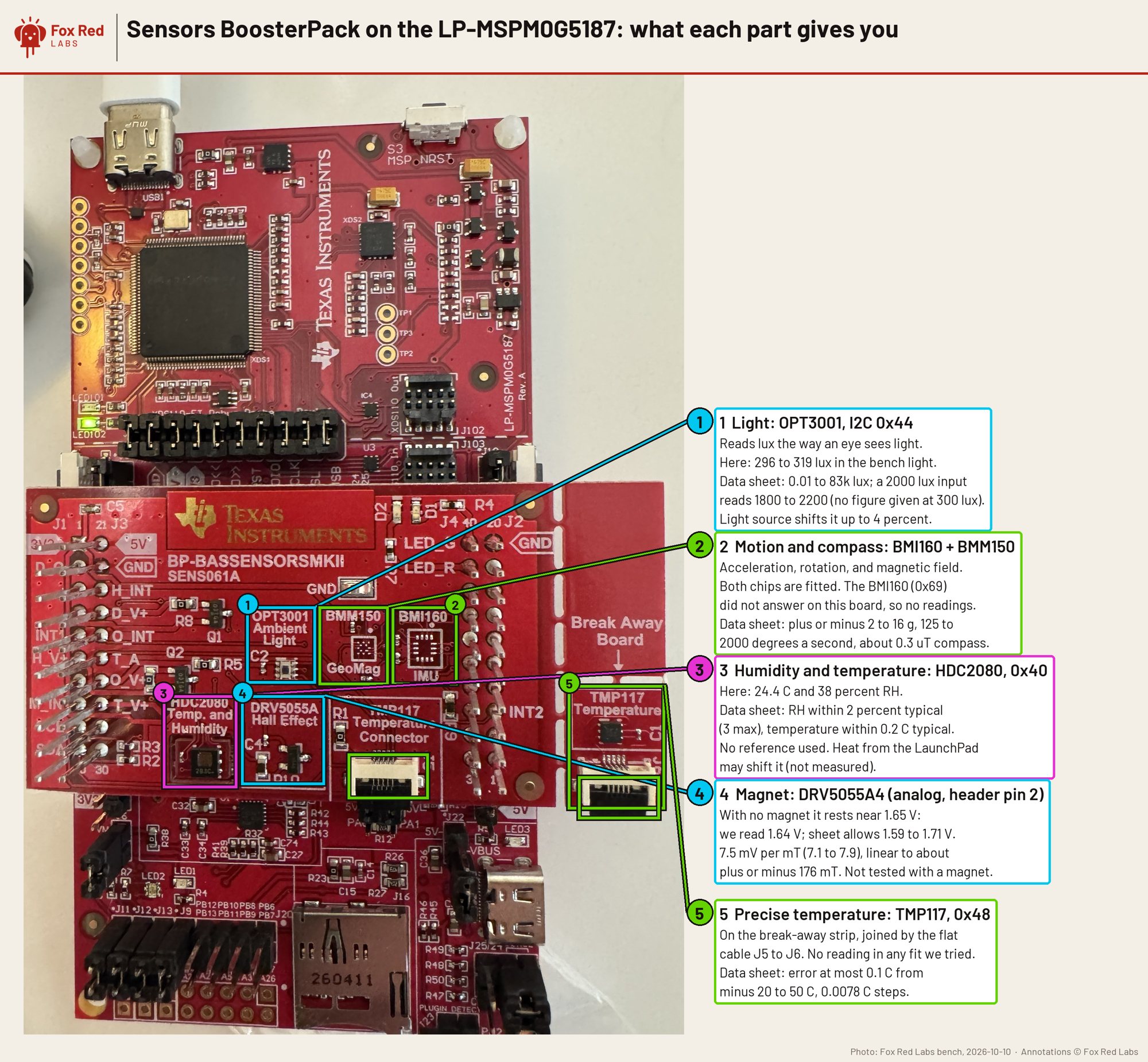
The BP-BASSENSORSMKII Sensors BoosterPack stacked on the LP-MSPM0G5187, with each sensor numbered and labelled with what it measures and what is read

A photo of the stack with each sensor numbered; the ribbon-cable sockets at the right are empty. The photo and the labelled picture are in the repo next to the README. Open full size

Six sensors on one BoosterPack: what you get, what is read, how accurate it is

You need

  • LP-MSPM0G5187 LaunchPad development kit: TI's 80 MHz Cortex-M0+ board with a TinyEngine neural accelerator, 128 kB flash and 32 kB RAM. The chip has USB and I2S audio. The board adds a microphone, an audio ADC, a microSD slot and a debugger that measures current.
  • BP-BASSENSORSMKII Sensors BoosterPack plug-in module: A plug-on board of TI and Bosch sensors on one I2C bus. The TMP117 reads temperature and sits on a break-away board with a ribbon cable. The HDC2080 reads temperature and humidity, the OPT3001 light, the BMI160 motion, with a BMM150 compass behind it, and the DRV5055 a magnet. Red and green LEDs.

Wiring

  1. No wires and no jumpers: press the BoosterPack straight down until its pin 1 (3V3) sits in the LaunchPad kit's J1 pin 1, with the USB cable unplugged
  2. The program switches the sensors on: pin 6 (PB22) low for humidity, pin 24 (PB15) low for the magnet sensor, pin 27 (PA15) high for light, pin 28 (PA12) high for the TMP117
  3. I2C on pins 9 (PA9, clock) and 10 (PA8, data); the magnet sensor's analog output on pin 2 (PA25)
  4. TMP117 only: the flat cable from J5 to J6, contacts down, black tab up; it only works one way round, and the wrong way kills the I2C bus (the TMP117 did not answer in any fit)
  5. Only the J1 and J3 header rows have pins on this LaunchPad, so BoosterPack pins 1 to 10 and 21 to 30 are connected
  6. The two LEDs (pins 39 and 40) and the motion sensor's second interrupt (pin 13) are not; the other alert lines are connected but the program does not read them

What was measured

  • Humidity and temperature (HDC2080): 24.3 to 24.5 C and 37.4 to 37.8 percent RH; the data sheet says within 2 percent RH and 0.2 C typical
  • Light (OPT3001): 296 to 319 lux in the bench light; the data sheet gives 1800 to 2200 for a 2000 lux input and no figure at 300 lux
  • Magnet sensor (DRV5055A4): 1.64 V with no magnet, against 1.65 V at rest in the data sheet (1.59 to 1.71 V guaranteed), assuming a 3.3 V ADC reference
  • TMP117 (flat cable tried in every fit, also with 3.3 V wired to its power pin) and the motion sensor (BMI160, fitted but silent): no readings, cause not found for either
  • No reference instrument was used, so these are not accuracy tests; the accuracy figures are the data sheets', at the conditions the guide lists

Versions: MSPM0 SDK 2.11.00.07, TI Arm Clang 5.1.1, SysConfig 1.26.3, MSPM0 G5187 Rev. A; run 2026-10-10.

Next: Try a second flat cable or the BoosterPack on another LaunchPad to see whether the TMP117 and the BMI160 answer there, then cover the light sensor and bring a magnet to the DRV5055. The light reading also feeds an occupancy model on the chip's neural accelerator..

How to repeat it: LP-MSPM0G5187 Sensors BoosterPack notes. Errors and fixes: FAQ. Numbers from raw log: UART 153202, raw log: UART 153402, raw log: bs 152553, Experiment: MSPM0G5187 NPU live light.

Get the code and tell us how it wentThe clone command, the board folder with its AGENTS.md, reports from others, and the three report forms.

Get the code

Clone the repository and open the board's folder below. AGENTS.md is a plain text file of notes for AI coding assistants, and llms.txt at the root indexes the site for one.

git clone https://github.com/Fox-Red-Labs/fox-red-labs.git

Code is BSD-3-Clause, writing is CC BY 4.0; third-party folders keep their own licenses.

Built it? Tell us

Built this, or got stuck? Report it on GitHub with a few short answers. Your report shows here in your words, marked as yours. A failure that repeats on the bench gets its fix here.